RIP Eddie Van Halen (1955-2020)
06 October 2020 • by Bob • Music, Guitar
This news came as an absolute shock when I heard it earlier today: Eddie Van Halen, Hall of Fame Guitarist Who Revolutionized Instrument, Dead at 65.
Like thousands of other guitarists, Eddie Van Halen (EVH) was my first guitar hero. His band, Van Halen, hit the music scene in 1978, which was the same time as I began to play guitar. I spent countless hours learning dozens of Van Halen's songs on the guitar and playing them live at various gigs throughout my younger days.
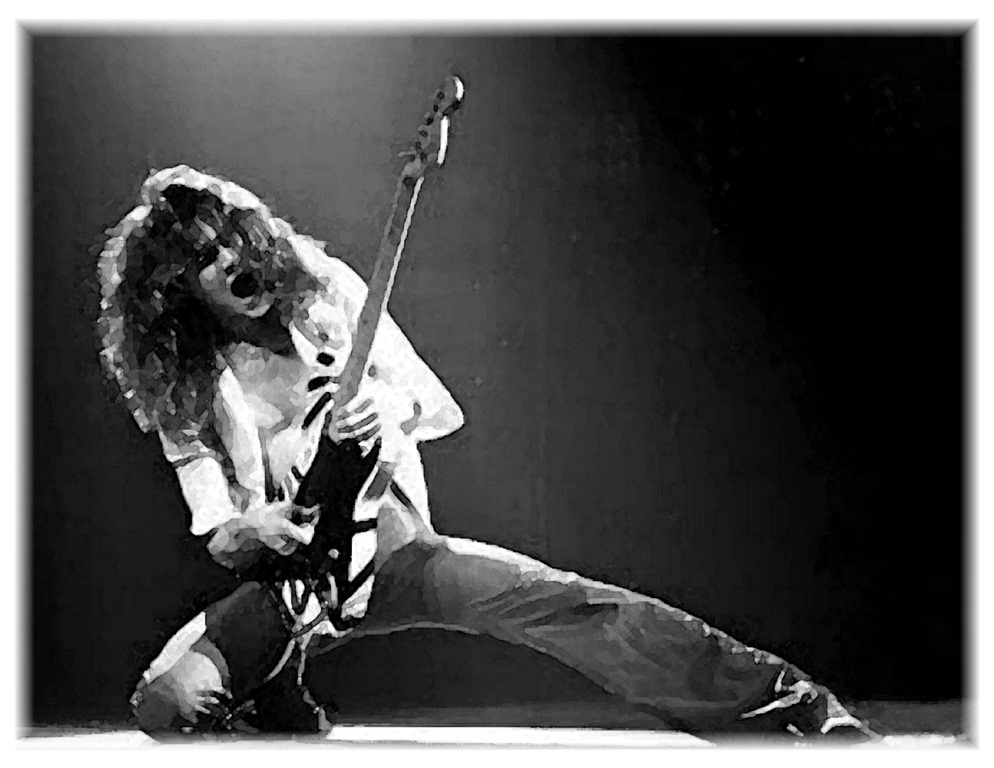
There are a handful of guitarists who I would say profoundly influenced my life as a musician, and EVH would easily be in my top five. EVH was a true pioneer, and his influence wasn't just on me; I think EVH inspired more guitarists than any other guitarist in history - even more than Jimi Hendrix, Eric Clapton, and Jimmy Page. As far as music in general is concerned, you could probably make the argument that few musicians in all of history have had as profound an impact, both for their instrument and their genre.
EVH's signature solo "Eruption" was the sound that launched a thousand imitators. While some might make the argument that this guitar player or that guitar player played this or that solo better than EVH, the fact remains that - for all intents and purposes - EVH did it first, and he did it better than anyone before him. EVH was a true innovator, whose technical skills and unique approach to the guitar was directly responsible for thousands of other people's careers.
I'm a big fan of Rick Beato's YouTube Channel, and a couple of years ago he created the following video, which describes Eddie's profound influence on guitar playing and rock music better than I could ever do.
EVH struggled with myriad health and substance abuse issues for decades, and it was great to hear that he was clean and sober from 2008 onward. But still - I think the years of physical abuse finally took their toll on him, and I was deeply saddened to hear that EVH lost his battle with cancer today at the young age of 65.
As I have grown older, it has been difficult to say goodbye to my childhood heroes. Chris Squire of Yes passed away in 2015, Keith Emerson and Greg Lake of ELP both passed away in 2016, and Neil Peart of Rush passed away in January of this year.
Despite the fact that I never met any of these musical influences, I somehow feel like I've lost several close friends. That isn't supposed to happen. Heroes are supposed to ride off into the sunset. They're supposed to be immortal. Heroes aren't supposed to die like ordinary people.
RIP EVH. You will be sorely missed.
POSTSCRIPT:
If I was to pick my top five six guitar influences they would be (in no particular order): Eddie Van Halen, Alex Lifeson, Steve Howe, David Gilmour, Randy Rhoads, and The Edge. While I have been influenced by dozens of guitarists, I can honestly say that something from each of the guitarists that I listed shows up in my playing almost every time I play the guitar. (For more about that train of thought, see my A Few of My Favorite Guitar Solos post from several years ago.)
A Few Thoughts about Trevor Rabin
04 October 2020 • by Bob • Music, Guitar
Trevor Rabin slowly emerged as one of my favorite guitarists. I first learned of him when he was working with Manfred Mann in the early 1980s. (Thankfully I had missed his debacles with the glam rock band Rabbitt.) When the song "Owner of a Lonely Heart" came out in 1983 and became a huge hit, I wondered what the heck Rabin was doing with Yes, and how badly would he ruin the band. However, that feeling evaporated as I heard more of the 90125 album. Oh sure, that particular musical offering was more about creating "pop music" than "progressive rock," but still - Rabin had some SERIOUS musical chops.
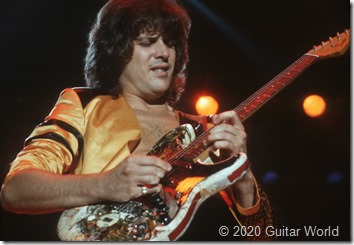
When I saw Yes in 1984 during the Tucson stop of their 90125 tour, Rabin upped his game to a whole new level in my estimation. He completely nailed songs from both catalogs of Yes' music - both the old and the new. In fact, I much preferred Rabin's live versions of classic Yes songs like "And You and I" and "Yours Is No Disgrace" over Steve Howe's live versions. Rabin was far more meticulous than Steve Howe at getting all of the guitar parts right in a live setting. On the other hand, Steve Howe seemed to wander all over the neck in a never-ending stream of musical ramblings on every live Yes recording, which often sounded like he was almost drunk. However, Rabin also added some unique parts of his own to those vintage pieces; I had to admit that Rabin added parts where Howe would never have thought to add them, and in the end I thought Yes' music with Rabin's additions were sometimes better than the originals.
After the Tucson concert had ended, a few friends and I met Yes backstage, and Trevor Rabin was one of the nicest guys you could ever hope to meet. After our group of friends had an informal meeting and autograph session with the entire band, most of the band members wanted to climb into their waiting limousines and speed off to their hotel for the night. But Rabin was involved in a great discussion about music with my friend Larry and me, so Rabin waved them off and said he'd catch up with the rest of the band later.
Larry was the drummer for a band that we were both in at the time, and our discussion with Rabin was simply about music - and that's it. Rabin wasn't acting like a rock star, he wasn't basking in the adulation of fans, and we weren't showering him with adoration and compliments. The three of us were talking about guitar effects, and production techniques, and songwriting, and about music in general. In short, this was simply three normal guys having a normal conversation about their favorite subject.
During the course of our discussion, I told Rabin that I thought he was a great replacement for Steve Howe, who was the predominant guitarist for Yes during the 1970s. I immediately sensed that I had touched on a sensitive subject, so I let it drop. However, some years later I was reading an interview with Rabin in a guitar magazine, and he said that the hardest thing for him while he was a member of Yes was constantly being compared with Howe. That's not what I meant to do, and I felt badly that I had been part of that experience for him.
A few years later I joined the US Army, and by the late 1980s I was stationed in Germany. If you've read any of my military-related posts, you'll know that I spent a lot of time out in the woods chasing bad guys. However, when I wasn't working, you would find me curled up with a Tom Clancy or Michael Crichton novel, and quite often I was listening to Trevor Rabin's Can't Look Away album. Once again, it was more of a pop music album, which was different than my general preference for progressive rock. Still, I had this album on cassette, and I nearly played it to death during my tenure there. The following video features the song "Something to Hold Onto" from that album, and it's a great example of just how weird an 80s rock music video could be.
In 1991, I caught Yes on their Union tour in Frankfurt, Germany. During this concert, I saw Rabin save the show when the audio for Howe's guitar dropped out during "And You and I." For some reason, Howe's sound vanished from the mix during the acoustic breakdown in the middle of the song. Rabin had been standing off to the side, but when Howe's guitar disappeared, Rabin jumped over to his pedal board, hit a couple buttons, and came up with a plausible acoustic sound to finish the section, with barely a moment or two of dead time. Thanks to the wonder of the Internet, I eventually found a video of that show. The camera was predominantly focused on Squire and Anderson so you can't see everything that's happening, but you can hear it. If you watch the following video, you can hear Howe's guitar disappear around the
Rabin eventually left Yes, and he spent several years writing soundtracks for movies. (IMDB currently lists him with 60 credits as a film composer.) However, in 2012 Rabin released his Jacaranda solo album, where he showed that he still hasn't lost his touch as a guitarist. In addition, the following video shows that he hasn't lost his touch with odd music videos, either.
In what would seem like a rare moment in musical history, the surviving members of Yes put their pasts behind them and teamed up to play a couple of their classic songs when they were inducted into the Rock and Roll Hall of Fame in 2017. (Quick side note: Chris Squire, the longtime bassist of Yes, had recently passed away, and Geddy Lee from Rush filled in for him.) It was nice to see Rabin back with the group, and to be honest - the following video shows that Steve Howe isn't aging well; his guitar chops are starting to fade, and he made several embarrassing mistakes. On the other hand, Rabin looks like he's having a ball, and he seems to have a great musical rapport going on with Geddy Lee. (Hmm. Perhaps the two of them should do a side project together?)
One day, I'd like to meet Trevor Rabin again and apologize for my poor choice of words from when I met him back in 1984. It's a poor excuse, but I was only 18 years old at the time. I honestly meant what I said to be a compliment, and I didn't realize how Rabin would receive that. Who knows? Maybe some day I'll get the chance.
POSTSCRIPT:
On a totally unrelated piece of trivia, the writer and director Joss Whedon is a big fan of Yes, and I recently learned he named his Mutant Enemy Productions company after the acoustic breakdown section of Yes' song "And You and I."
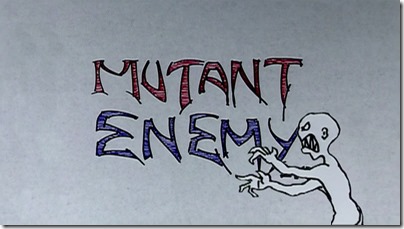
The lyrics for that section of the song are:
"Sad preacher nailed upon the colored door of time.
Insane teacher be there, reminded of the rhyme.
There'll be no mutant enemy we shall certify;
Political ends as sad remains will die.
Reach out as forward tastes begin to enter you."
You can store that piece of trivia awesomeness for a rainy day...
Modding Aviom Headphone Jacks
24 September 2020 • by Bob • Music, Technology
If you've played music in a live setting sometime within the past decade, chances are that you've used some sort of
Needless to say, these systems are great, and one of the

These Aviom systems work great, but they have one nagging design flaw that I hear about from everyone I know who has used them: the headphone jacks are soldered to the circuit boards, but they're not secured to the case with a nut. As a direct result, the headphone jacks eventually separate from the circuit boards, causing the mixers to lose signal to one or both ears. And this happens a lot.
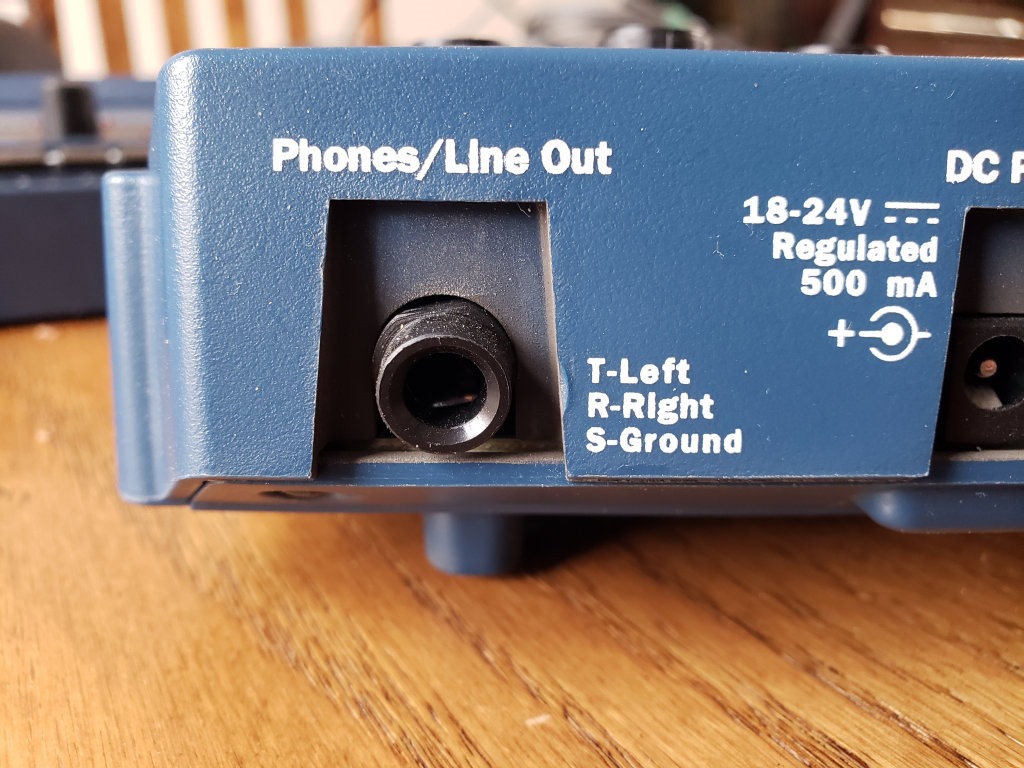
Thankfully, there's an easy mod that you can perform on your Aviom systems to make up for this design flaw: you can remove the headphone jack from the circuit board, and replace it with a headphone jack that is mounted to the case. This is a pretty simple hack, and it usually takes me around 10 minutes per mixer to swap out the parts. With that in mind, you might want to modify all of your mixers at the same time. (Which is what I chose to do.)
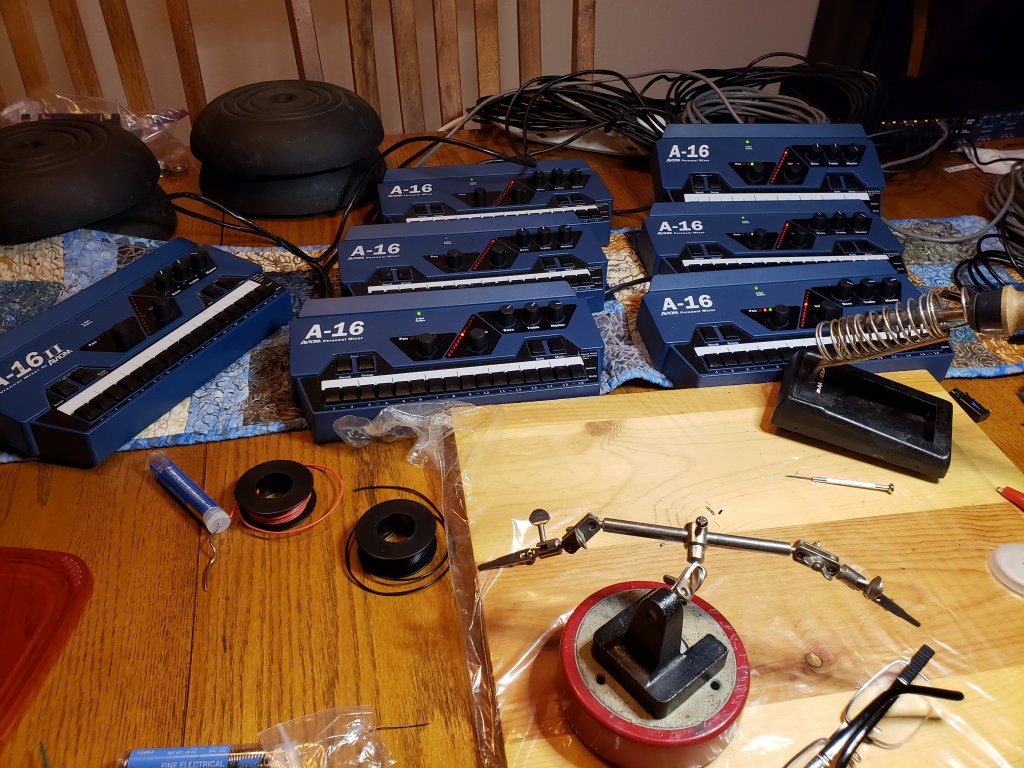
MODIFICATION INSTRUCTIONS
To perform this modification, you'll need:
- A stereo panel mount jack to replace the old headphone jack
- A small spool of wire to connect the panel mount jack to the circuit board
- A small screwdriver to assist with removing buttons
- A soldering iron, some solder, and basic soldering skills
- OPTIONAL: Alligator clip wires for testing
- OPTIONAL: Electrical tape to insulate the circuit board
WARNING: This modification will probably void your warranty. But these personal mixers are old enough that yours probably aren't under warranty anyway. But still, you might want to check.
STEP 1 - Remove all of the knobs and buttons from the front panel. The knobs should pull right off, but sometimes I need to use a small screwdriver to pop off the buttons. (Note: keep track of which buttons came from where, because several of the buttons have different holes that let the LEDs shine through.)

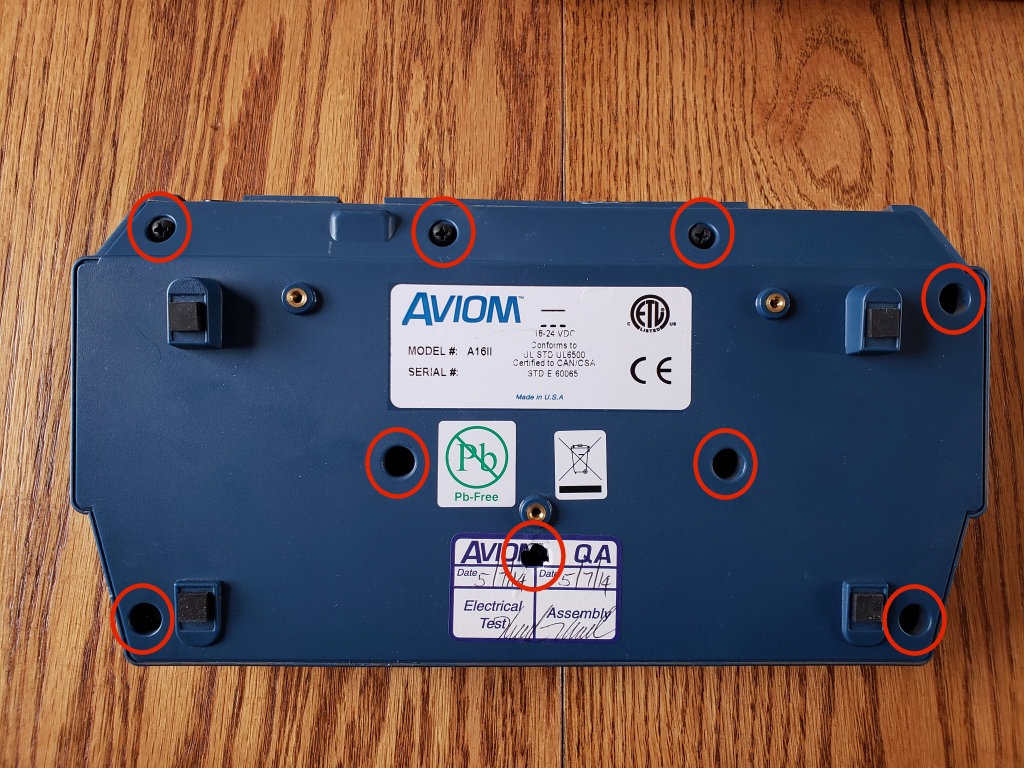
STEP 2 - Remove the screws from the bottom panel, and I've highlighted all of their locations in the image below. The only tricky part about this step is that one of the screws is probably hidden under one of the labels, which is undoubtedly to prevent people from modifying their Avioms and voiding their warranty.
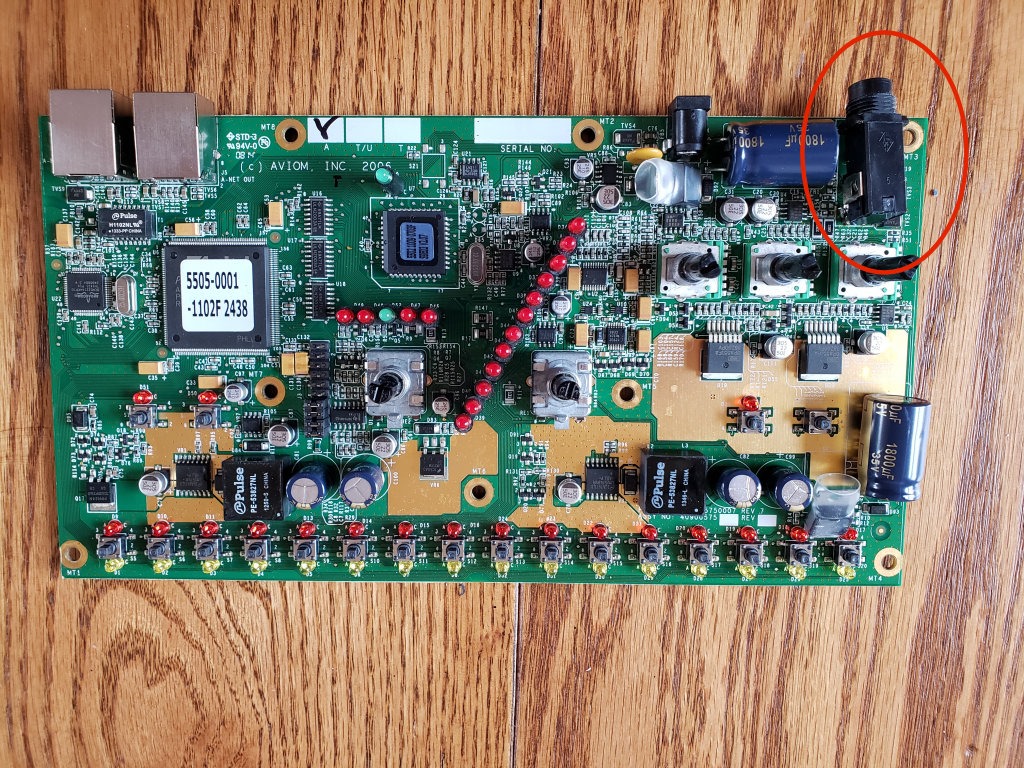
STEP 3 - Open the case and remove the circuit board. Once you have the circuit board removed, you can locate the headphone jack, which I have highlighted in the following image.
STEP 4 - Remove the headphone jack that is mounted to the circuit board. In every situation where I've replaced a headphone jack, I was able to simply pop them off the circuit board without doing any damage, which is probably because the continuous abuse of plugging and unplugging headphones has usually separated the headphone jack from the circuit board already, which is why this mod is necessary. However, if you try to remove the old headphone jack and it doesn't seem to want to move, you should desolder the old jack instead of forcing it.
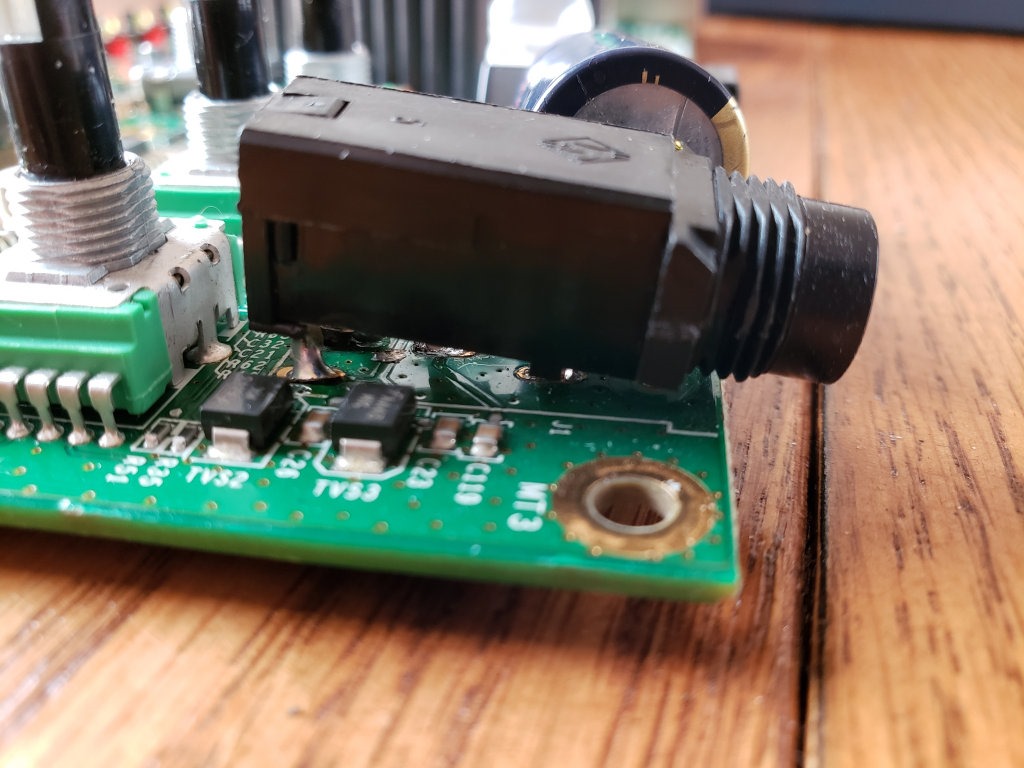

STEP 5 - Solder wires onto the circuit border in the locations shown in the image below. Pay attention to where the ground, left, and right wires are soldered. As you can see in the image, I use alligator clip wires to test out my soldering before I solder the wires to the new stereo jack.

STEP 6 - Solder the new stereo jack to the wires, then test out the circuit before reassembling the mixer.
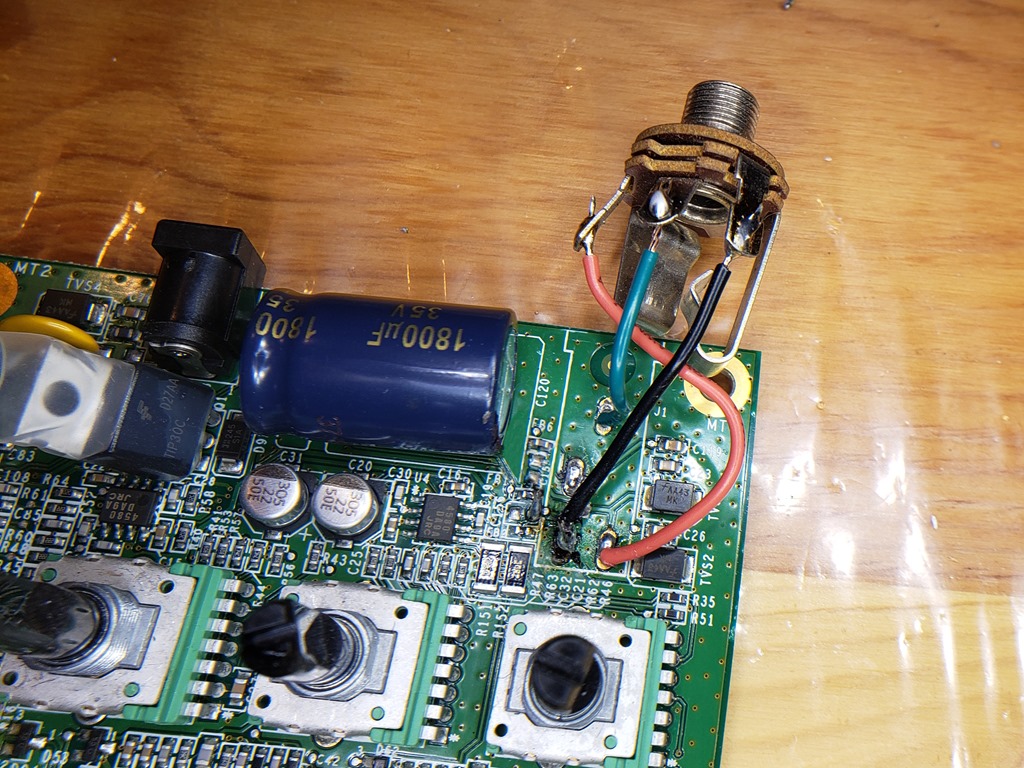
STEP 7 - Mount the new stereo jack to the case. While it may not be necessary, I usually place a piece of electrical tape on the circuit board where the jack will be located, and I do this to keep the new headphone jack from coming into contact with the circuit board.
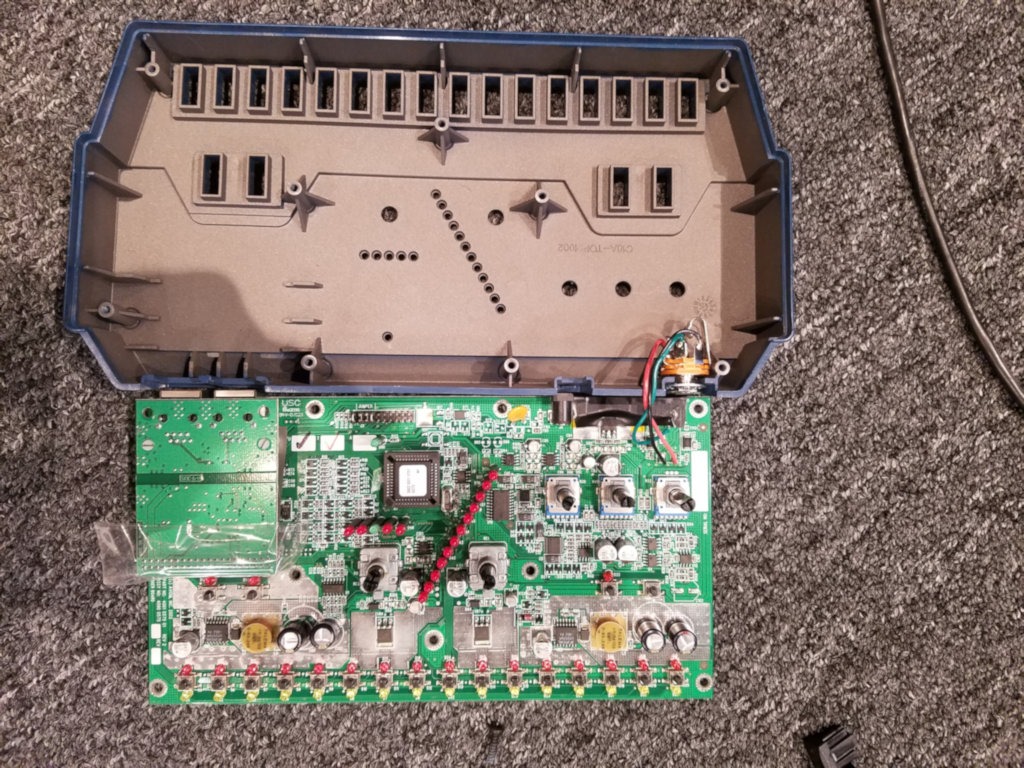
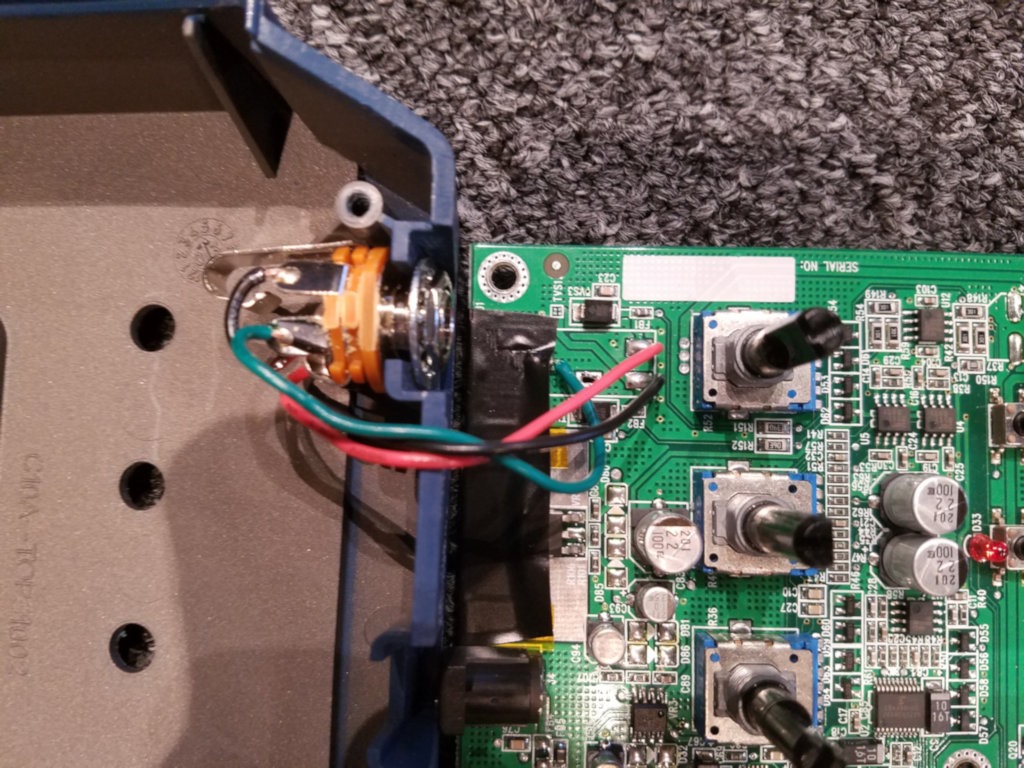
STEP 8 - Secure the circuit board in the case, assemble the two halves of the case back together, and then replace all the screws, knobs, and buttons. (Make sure that you put the buttons back in the same locations where they were before the modification.)
That's all there is to it!
The first mod that you do might take a little bit longer as you get the hang of it, but once that's out of the way, any remaining mods should be quicker.
BONUS TIP:
There is one extra step that you can take in order to improve the stability of your Aviom systems. If you're using the stand adapters that allow you mount your Aviom systems on microphone stands, there's an additional hack that I use which you might want to consider. I plug a right-angle headphone adapter into the Aviom's headphone jack, then I plug a six-foot headphone extension cable into the right-angle adapter, and then I secure the headphone extension cable between the Aviom mixer and the stand adapter so that it cannot be pulled out of the right-angle adapter. This system will prevent the cable from being ripped out of the headphone jack, and if you're using heavy microphone stands, anyone who walks away from the Aviom system with their

Remembering Tucson's Bob Cooke
16 September 2020 • by Bob • Arizona, Tucson
I grew up in Tucson, and I have fond memories of a local radio DJ that many people in town loved to listen to back in the late 1970s and early 1980s. However, to put things in perspective, radio isn't the same as it used to be; more and more of the contemporary radio programming is syndicated, playlists are dictated by countless business decisions, and - to be honest - fewer and fewer people are listening to radio as it fights to compete with satellite services, streaming apps, and digital audio. (I will admit, I personally listen to a collection of MP3s that are stored on a flash drive whenever I'm traveling in my car these days.)
But back in the late 1970s and early 1980s, radio was king. For most music fans, radio was usually the only way that you discovered new artists, and it was also how you learned that your favorite artists had released their latest albums. There was no Internet back then, and before MTV launched in 1981 there was generally no television coverage for rock music news. In short, if you liked music, there was radio - and that was it.
When I was in High School, there were two rock stations in Tucson: KWFM and KTKT-FM (which would later become KLPX). Each station had their fair share of DJs, and there was one DJ who drifted back and forth between those two stations: Bob Cooke. He was Tucson's premier funny man - he always had the best jokes, but he was never over the top. (Well, perhaps on occasion...)
I recall staying up late on far more nights than I will admit to finish homework assignments as my semesters came to an end, and Bob Cooke always played requests from students all over town who were engaged in similar

One of the particularly amusing parts of Bob's shows was when he was required to read advertising copy live while on the air, because he could never do it without messing with the scripts that he had been handed. I vividly recall one morning when he was reading the advertisements for Farmer John's Sausage Links, which Bob humorously changed to "Farmer John's Wieners." He kept saying the rest of advertising copy incorrectly, and therefore he had to keep starting over. However, restarting the script meant that he would eventually run out of the music that was supposed to play in the background, so he would have to start over - again and again. The entire episode was side-splittingly funny, and I laughed so hard I probably cried...

People who grew up in the "Naked Pueblo" (as Cooke used to call Tucson) will remember that Bob was tragically killed by a deranged radio listener in August, 1982. (See https://bit.ly/2RswW5o.) People throughout the Tucson valley mourned his untimely death at the young age of just 28 years.

It's hard to believe that it's already been 38 years since his murder, because I can still remember countless hours listening to Bob's priceless and bizarre sense of humor. I'm sure that he would have retired years ago if he had had the chance to live a full and happy life, which means both Bob and the classic radio format that made him famous might have been able to ride off into the Arizona sunset together.

Christian Progressive Rock is a Small but Necessary Genre
02 September 2020 • by Bob • Music, Guitar
I mean no disrespect to anyone - including my wife - but I personally find the majority of what is called "worship music" within the church to be insufferably boring when heard outside of a formal church service.
99% of the time that music is based around some arrangement of the I ii IV and V chords, with the occasional vi chord to mix things up.
I'd also say that 90% of the time that music has a time signature of 4/4, with another 7% of 3/4, and the remaining 3% being mostly of 6/8.
Adding insult to injury, most of the contemporary "worship" lyrics are utterly pedestrian and predictable. You could take a list of about 100 words from popular "worship songs" and write them on 3x5 cards, then toss them on a table and arrange them in some sort of random order and you'd pretty much have recreated the next Chris Tomlin "hit."
There was a time that I was working on an "Instant Worship" website as a joke, which would have used something akin to a "Mad Libs" type of algorithm to kick out random lyrics with bogus chord charts based on everything I have mentioned in the preceding paragraphs.
Suffice it to say, if it were not for prog I would have gone crazy years ago. I accepted Jesus in my late teens in 1984, and I spent years listening to a conglomeration (or conflagration?) of Christian music's "rock" offerings. Bands like Petra were the powerhouses in that genre, and yet - I had been listening to Rush and Yes and Genesis and a host of prog bands before my salvation; Petra was nowhere near the level of musicianship or complex arranging as secular proggers.
I had heard of Phil Keaggy in the late 70s, but it wasn't until I heard King's X in the early 90s that I thought, "Wow - a Christian band with serious prog skills." (Yes, I know King's X seriously backslid in later years, but in their heyday they were awesome.)
Iona and some other Christian proggers came along later, and several pieces from Iona's catalog definitely hit the mark. Although I know several prog fans who grow quickly tired by their Celtic influence. (Irish music doesn't appeal to everyone. Although I'm of Irish heritage so it works for me.) But still - I often feel that there's an itch that I just can't scratch when I think about Christian music. (Which, by the way, is the only music I buy.)
These days I have been particularly impressed by several of the spin off projects and musicians who are operating with Neal Morse's realm of influence. See the following video for an example of what I mean, although that particular song is more a pop/rock piece than prog until you get to the bridge, but having seen them live, holy cow - amazing musicians.
Some of the projects involving Matt Smith of Theocracy are also great. See the following video for Project Aegis as an example.
With all of that being said, more often than not I find that I cannot kick back and enjoy most of what exists within the banal realms of what Christian music typically has to offer, but I can get totally lost in a great prog piece of music.
UPDATE:
Much of what was written above was extracted from a post that I had made in the Christian Progressive Rock Online Gathering (CPROG) group on Facebook. Someone challenged my statements about Iona, to which I replied:
"Pieces here and there from Iona's catalog definitely hit the mark; that's why I intentionally singled them out. Although I know several prog fans who grow quickly tired by their Celtic influence. (Irish music doesn't appeal to everyone. Although I'm Irish so it works for me.)
However, if you look at the brilliance behind albums like Fragile from Yes, or Lamb Lies Down on Broadway from Genesis, or Brain Salad Surgery from ELP, or Permanent Waves from Rush, etc., I can think of no albums in their entirety from the Christian Prog genre that approach those masterpieces. Because if they did, they'd also be popular outside of the incredibly tiny genre that is Christian Prog. So to reiterate: Iona is some of the best that Christian Prog has to offer, but overall - the Christian Prog genre is seldom everything that it could (or should) be.
PS - I should add that I have everything that Iona produced, to include their live videos. As far as Iona is concerned, I am quite the fanboy, and one of my regrets is that I never had the chance to see them live."
And then, much to my horror, Dave Bainbridge - one of the musical visionaries behind Iona - posted the following:
That's great Robert. Have you heard my albums Celestial Fire, and Veil of Gossamer? Both are more 'progressive' than most of my work with Iona. https://www.musicglue.com/iona/shop/categories/dave-bainbridge
I had to quickly re-read all of my earlier statements to see if I'd insulted Iona in any way... which I probably did. Not by intention, of course, but still... crap.

Yup, there's nothing quite like inadvertently insulting one of your favorite musicians in a public forum to remind yourself that anyone can read what you say.
Gary Numan - Forerunner of the Emo Genre
15 July 2020 • by Bob • Music
If you'll indulge me for a moment, I thought it would be fun to look at some music history and give you a laugh at a particular subgenre that used to be enormously popular, why it was important decades later, and where it's at now.

During the late 70s/early 80s, British New Wave and Synth Pop rose from the ashes of the quickly collapsing British Punk era. For what it's worth - I hated 1970s British Punk. I thought that the bulk of what that genre produced was absolute crap. However, several extremely popular bands emerged out of British Punk's decline; for example: U2, The Police, The Cure, Joy Division, and a host of other artists. Part of what made the British New Wave scene enormously successful was a heavy dependence on an explosion of new synthesizer technologies during the advent of the digital age. These new types of synthesizers were extremely popular on both sides of the Atlantic, but British Synth Pop bands used them differently than their American counterparts. For example, see bands like Depeche Mode, Tears for Fears, Yazoo, Orchestral Manoeuvres in the Dark, Erasure, etc.
FWIW - the following excerpt is from the Synth Britannia documentary, which is an excellent expository about the British Synth Pop genre. The original documentary is long, but it's amusing, and it's pretty nostalgic for those who listened to British New Wave during its heyday.
However, this excerpt is about one artist who had a slightly different take than his musical contemporaries, and that was a vocalist named Gary Numan. He had a string of hits, and I will freely admit that his style is probably not most people's cup of tea. That being said, for a good example of Numan when he first hit the music scene in the late 1970s, see the following performance of his "Are Friends Electric" on BBC's "Top of the Pops," which was the TV show that you were invited to play in England when you had "arrived" as a musician. (PS - A lot of British artists became superstars overnight after playing on "Top of the Pops.")
As I said, Numan probably isn't many people's style, but that video is really funny when you think about it from an 80s perspective; the weird costumes, the strange lyrics, Numan's odd voice, and a plethora of synthesizers. And this is where Numan seemed to create his own subgenre that was a departure from his fellow synth-based colleagues, which we liked to refer to as "Science Fiction Rock" at the time, because there was something otherworldly about his approach.
However, recently Numan revealed that he has Asperger syndrome, which makes his success even more amazing. Performances like "Top of the Pops" might have been somewhat easier for Numan, because they were in a tightly controlled environment. Yet Numan was required to tour to sell albums, which makes performances like the following example all the more spectacular when you consider how hard it was for someone with Asperger syndrome to be in front of thousands of people.
I still freely admit that this additional video is probably even less appealing to many people. Although it's interesting, because it shows something that happened at a lot of his shows: he would spontaneously start laughing, but not lose his place. I think I heard Numan laugh on every live recording of him from back in the early 80s. I had always assumed that he was simply enjoying himself as a performer, but now I wonder if it was more of a coping mechanism of Asperger's.
Jumping ahead a few years in the music world, you can see how Numan was the progenitor for the later Emo genres. For example, here is "Are Friends Electric" in 1989, which is ten years after his "Top of the Pops" performance.
And the same song in 2003, which is 20+ years later than his TOTP performance.
Note that I am using live versions of the same song simply to illustrate Numan's evolution over the years, and how he was always "Emo" before the industry caught up with him.
A good friend of mine from my late 70s/early 80s high school days just sent me the following video of Numan performing "Are Friends Electric" from a few years ago.
All of that brings us today's world. Numan's music has continued to change over the years, and the following video shows Numan performing "Are Friends Electric" with the Skaparis Orchestra.
I find it admirable that Numan is still performing despite his having Asperger syndrome; although to be honest, his more recent live videos have seemed as though he's a little less socially awkward in front of a crowd. Regardless, it's clear that he's still willing to evolve musically. But if it hadn't been for artists like Numan (and a few artists like him - e.g. Morrissey), we probably wouldn't have had the Emo genre. (That could be good -or- bad, depending on whether you like Emo. Personally, I think it has it's place.)
UPDATE: I mentioned earlier that I wanted to use Numan's performances of "Are Friends Electric" over the past 40 years just to chart how Numan changed and evolved musically, but I think it's worth taking a complete departure and showing some of the cool things that Numan has done more recently; like last year for example. To see what I mean, take a look at the following videos.
Personally, I think Emo music with Middle Eastern themes and an orchestra/choir works for Numan. His music is probably not most people's style, of course, and it's not necessarily my style, either. That being said, I still think it's... interesting.
01/04/2022 UPDATE: The Produce Like A Pro channel on YouTube just posted the following video, which has additional information about Gary Numan and his contributions to electronic music that people might find interesting.
The Awesome Spectacle of Cygnus X-1
05 June 2020 • by Bob • Music
Back in my high school days when I was playing in rock bands, we would try to play Rush's Cygnus X-1, because it was nearly impossible to pull off. And it is probably for that reason that Rush didn't play it that often, either.
However, Rush pulled out all the stops on their final R40 tour, and they added this epic piece to their set list. But when the DVD was released sometime later, you couldn't appreciate the full spectacle of just how awesome the lights and lasers were during this instrumental.
The other day I happened to discover someone's cell phone recording from the back of the theater during the R40 show, and I combined it with the DVD's stage footage to create the following picture-in-picture video. (The picture-in-picture overlay kicks in around the 20-second mark.)
For all of the Rush fans out there - enjoy. For all of the non-Rush fans, it's okay - Geddy doesn't sing on this one.

Transcribing Shallow by Porcupine Tree
25 May 2020 • by Bob • Guitar, Music
One of the things that I like about certain pieces of music is "groove," which is hard to describe in words - but you'll know a good groove when you hear one. Several of the pieces that I have transcribed in the past fall into the "great groove" category, which is largely why I transcribed them in the first place; the groove of each respective piece got under my skin, and today's transcription clearly belongs in that collection.
Without further discussion, here's my transcription of "Shallow" by Porcupine Tree. (See https://youtu.be/tIgONIbYSyY for the original song.)
Here are my notes about this transcription:
- The most-glaring omission from this transcription is the organ part; it's featured in the second verse and in other places, and I didn't bother to transcribe it because - I didn't want to. So there.
- I tried to dial in the piano part, but even I can tell that it's not perfect. To be honest, this transcription was more about the guitar/bass/drums.
FWIW - I originally transcribed this song several years ago, but I was thinking about it the other day, and I decided to revisit it. After making a bunch of changes, I decided to post the revised version as a blog, which will hopefully help someone in the future.
That's all for now. Enjoy!
Happy Pi Day 2020!!!
15 March 2020 • by Bob • Humor, Music
A couple years ago I created a piece of music for "Pi Day" from the first 256 digits of Pi. I won't bother to go into the details for that experiment, save to say that I simply took the numbers from Pi and added those to a root note of a major scale and let the notes fall where they may. This was a pretty simple exercise, and I'd been kicking around an idea for a much better exercise ever since.
With that in mind, given the proximity to St. Patrick's day, I decided to create a new piece with an Irish feel.
Here's what I did for this experiment:
I chose to use a
However, while I was entering the notes and listening to the playback, many of the notes were often too far apart from their surrounding notes, with very strange octave jumps, which made the whole piece sound random. With that in mind, I decided to use modulus division to cut the range in half, thereby forcing all of the notes into a
This change for my second draft of this experiment resulted in a much smaller scale of
My good friends Randy Clepper (www.randyclepper.com) and Mark Wade (www.markalanwade.com) have taught a lot of classes about Irish ornamentation. I leveraged some of the things that I learned from them, and I added "cuts" to each of the sections where there were two notes that needed to be separated. By way of explanation, a "cut" is when you play a quick grace note above the note that is in the melody line. So if you have a A followed by an A in the melody, you would play the first A of the melody, then jump up quickly and play a B before returning to the second A of the melody, making sure to land the second A of the melody on the beat where it belongs. (Depending on the instrument that you are playing, you would play a cut by playing the first A of the melody, then hit a grace note A before jumping to the grace note B, and returning to the second A of the melody. It's like a really fast triplet.) Once I added the Irish ornamentation throughout the piece, it contributed significantly to the Celtic feel.
The drum beat was another exercise in self-indulgence that was fun to do. Because this entire experiment is about math, I chose to create a "Slip Jig," because they're in a
Lest I forget, the
And last but not least, the 157 bpm tempo that I chose to use was derived from taking 314 (e.g. "3.14") and dividing by 2. ('Cause, you know - more math.)
Transcribing Black Flag by King's X
06 March 2020 • by Bob • Guitar, Music
I had this song stuck in my mind for a few days, and occasionally the best way to get a song unstuck is to transcribe it. With that in mind, here's my transcription of the King's X song "Black the Sky" from 1994. (See https://youtu.be/OtOb2_3YOCE for the original song.)
This piece is a perfect illustration of how cool "Drop B" tuning can be... and transcribing it made me seriously regret selling my 7-string guitar. 
Once again, my transcription is pretty faithful to the original, and here are the main differences that I can think of:
- Ty Tabor used a wah pedal to play the guitar solo, but I used an autowah for my transcription playback. That's because I didn't feel like manually notating all of the wah pedal wizardry that Ty was doing. Was that laziness on my part? Perhaps. But the autowah sounded good enough for me.
- At measure 14, Ty changes the chords on the first pass and the second pass through the chorus. However, I wanted to make the transcription a little easier to read/write, so I notated the chords from the second pass through the chorus. Was that laziness again? Perhaps. Deal with it.
- I have to admit, there are parts of my bass arrangement that lend themselves to Tim Starace's excellent bass cover of this song on YouTube. (Tim plays it much better than I would, though.)
On a related side note, I have transcribed a few pieces by King's X, and one thing that I've learned to appreciate is Jerry Gaskill's drumming. I grew up listening to guys like Neil Peart, Bill Bruford, Carl Palmer, Mike Portnoy, etc. In other words, I predominantly grooved to the giants of the Progressive Rock genre. But there are certain drummers - like John Bonham - who lay down a steady groove that underscores a lot of cool stuff that's going on in the rest of the piece. (See https://youtu.be/UvOm2oZRQIk.) With that in mind, Gaskill's drum parts are never mind-blowing, but they definitely create a solid foundation. (And of course, Jerry sings harmony while playing, so he's got that going for him, too.)